

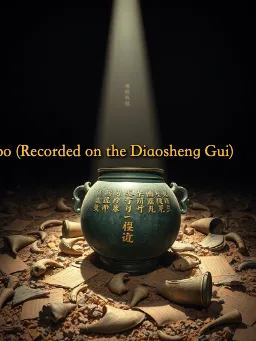
Case Summary
This case, recorded on the bronze vessels known as the “Diaosheng Gui” (including the Five-Year and Six-Year Gui and the Five-Year Zun), details a land dispute in the late Western Zhou period. The noble Diaosheng was repeatedly accused of illegally opening private fields and keeping excessive servants, a violation of the law. When the royal court assigned Zhaobohu, a fellow clan member, to investigate, Diaosheng attempted to bribe him. He first gave a bronze hu to Zhaobohu’s mother and a jade zhang to his father, seeking their intercession. Due to this influence, the lawsuit was resolved in Diaosheng’s favor the following year. To commemorate his victory and the protection offered by his powerful clan relatives, Diaosheng cast these ritual vessels. The case is a vivid example of the intersection of law, bribery, and clan loyalty in ancient China.
Status or Result:
The case concluded not through a formal legal ruling, but through the internal mediation and influence of the senior clan members. Under the direction of the patriarch Junshi, who stated she did not wish to pursue the matter, a resolution was reached: the land and servants were reallocated, with the main clan lineage taking a larger share and Diaosheng retaining a smaller portion. Zhaobohu presented this outcome to Diaosheng as a victory, confirming that the litigation had been quelled. The final step involved registering the redistributed properties, effectively granting them a form of official recognition. This outcome exemplifies the power of clan hierarchy to supersede royal law in resolving disputes.
Key Disputes
1. Whether Diaosheng’s large-scale reclamation of private fields and retention of excess servants were illegal under the laws of the Western Zhou Dynasty.
2. Whether the actions of Zhaobohu and his parents constituted bribery and a perversion of justice, or were a legitimate exercise of the obligations of the clan patriarchy (大宗) to protect a junior branch (小宗) under the zongfa system.
3. The ambiguous boundaries and ownership of the contested land, which gave rise to the initial litigation and the subsequent internal redistribution of clan property.
Social Impact
1. **Historical Record**: This is arguably the oldest documented bribery case in Chinese history, providing crucial primary-source evidence for understanding the actual mechanisms of dispute resolution beyond formal legal codes.
2. **Legal System**: It reveals that the Western Zhou legal system could be heavily influenced and even overridden by the powerful patriarchal clan structure (zongfa), where loyalty to family often trumped state law, a recurring theme in Chinese political culture.
3. **Land System**: The case demonstrates the increasing privatization of land (“opening of private fields”) and the breakdown of the idealized “well-field” system during the late Western Zhou, pointing to significant economic shifts.
4. **Cultural Significance**: The act of recording this legally dubious victory on sacred ritual bronze vessels for ancestor worship has sparked scholarly debate, suggesting a starkly different cultural perspective on what constituted honor and a worthwhile family achievement compared to later eras.
Google Ads
Adapted Novels (1)
Feedback & Corrections
No comments yet. Be the first to comment!