

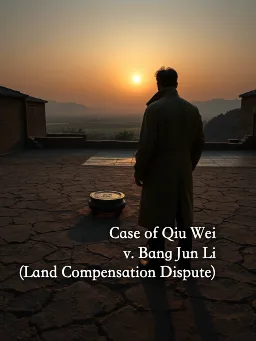
Case Summary
In the fifth year of Western Zhou King Gong's reign, the minor noble Qiu Wei (裘卫) brought a complaint before five high-ranking ministers (Xing Bo, Bo Yifu, Ding Bo, Qiong Bo, and Bo Sufu) against his neighbor, the feudal lord Bang Jun Li (邦君厉). The dispute centered on a broken promise for land compensation. Bang Jun Li had been ordered to undertake a river management project on royal lands, which required the use of some of Qiu Wei's property. Li had originally pledged to compensate Wei with five fields (田五田). However, after the work was completed, Li failed to fulfill this promise. The ministers questioned Li, who admitted to the original agreement. Following mediation, the compensation amount was adjusted from five fields to four fields (田四田). Li swore an oath to abide by the agreement. Subsequently, officials (the Three Supervisors: Situ, Sima, and Sikong) and an inner scribe were dispatched to survey the land, demarcate its boundaries, and formally transfer the four fields from Bang Jun Li to Qiu Wei. The entire proceeding was inscribed on a bronze ding vessel, known as the Wu Si Wei Ding (五祀卫鼎).
Status or Result:
The panel of ministers resolved the case through mediation rather than a unilateral judgment. The initial compensation promise of five fields was renegotiated down to four fields, to which Bang Jun Li agreed. He was then compelled to swear a binding oath to fulfill this obligation. The state then enforced the agreement by sending officials to officially survey, demarcate, and transfer the four fields to Qiu Wei, who recorded the outcome on the Wu Si Wei Ding.
Key Disputes
The central dispute was whether Bang Jun Li was obligated to honor his verbal agreement to compensate Qiu Wei with land for property taken during a state-commissioned flood control project. The case highlights the tension between a feudal lord's public duties and private property rights, and the enforcement of oral contracts in early Chinese society.
Social Impact
The inscription on the Wu Si Wei Ding provides the earliest and most complete judicial archive of a land dispute resolution in China, offering invaluable evidence for studying Western Zhou legal procedures. It demonstrates that a structured judicial process—including complaint filing, joint hearings, mediation, oath-taking, and supervised enforcement—existed for resolving aristocratic disputes. The case illustrates the tension between the traditional "land cannot be sold" (田里不鬻) policy and the emerging de facto private land ownership, marking a significant evolution in the property regime of the mid-Western Zhou period. It also embodies a legal culture that valued mediation and harmony (以和为贵) alongside formal adjudication.
Google Ads
Adapted Novels (1)
Feedback & Corrections
No comments yet. Be the first to comment!