

Case Summary
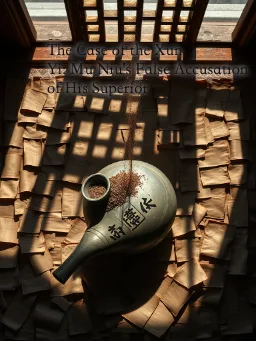
This case, inscribed on the Western Zhou bronze vessel "Xun Yi" (训匜) unearthed in Qishan, Shaanxi, is recognized as the earliest and most complete judicial verdict record extant in China. Mu Niu, a lower-ranking official, brought a lawsuit against his superior Xun over a dispute concerning the ownership of five slaves. The Zhou king assigned the judicial officer Bo Yangfu to adjudicate the matter. Bo Yangfu determined that Mu Niu, by suing his superior, had violated a prior oath of allegiance and committed the offense of false accusation, an act of insubordination. Initially, Mu Niu was sentenced to a thousand lashes, facial tattooing (墨刑), and the wearing of a black cloth. Subsequently, because Mu Niu voluntarily reconciled with Xun and returned the five slaves, Bo Yangfu progressively mitigated the sentence, ultimately commuting it to five hundred lashes and a fine of three hundred lüe (锾) of copper, on condition that Mu Niu swear a new oath not to repeat the offense. The case documents were archived, and Xun used the fine to cast the bronze vessel as a memorial of his vindication.
Status or Result:
Mu Niu was found to have committed false accusation and breach of oath. His original sentence of one thousand lashes, facial tattooing, and permanent black-cloth covering was successively reduced in recognition of his reconciliation and restitution. The final judgment imposed a reduced corporal punishment of five hundred lashes and a fine of three hundred lüe of copper, coupled with a mandatory oath barring any future litigation against his superior.
Key Disputes
Whether Mu Niu's act of suing his superior constituted a criminal offense of false accusation and a breach of oath, rather than a legitimate civil claim over property. The core conflict was between the ritual-based prohibition against an inferior suing a superior and the nascent legal procedure for resolving property disputes.
Social Impact
The Xun Yi inscription, often hailed as a "Bronze Code," provides concrete evidence of a remarkably sophisticated judicial system in the Western Zhou, encompassing complete procedures for trial, cross-examination, reconciliation, judgment, commutation, execution, fine collection, and archival management. It substantiates the "Mingde Shenfa" (illustrious virtue and careful punishment) ideology recorded in the "Shang Shu: Lü Xing," particularly the practice of redeeming corporal punishment through monetary fines. The case also illuminates the rigid hierarchical structure of Western Zhou society, where the ritual prohibition against inferiors suing superiors profoundly constrained legal agency, making it a seminal record for understanding the intersection of law, ritual, and social stratification in early China.
Google Ads
Adapted Novels (1)
Feedback & Corrections

No comments yet. Be the first to comment!